
By: w wangzei konyak
Posted on: 12 Jun 2025
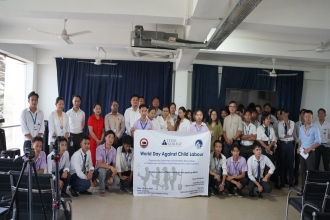 Chümoukedima, Nagaland – June 12, 2025:
The District Child Protection Unit (DCPU), under the Department of Social Welfare, Government of Nagaland, observed the World Day Against Child Labour at Tetso College, Sovima. This year’s theme was “Progress is clear, but there’s more to do: let’s speed up efforts.” The program focused on spreading awareness and encouraging stronger action to protect children from exploitation
Labour Inspector Calls for Reflection
Ms. Suneplila Tzudir, Labour Inspector, Dimapur, delivered a powerful address."Today is not a moment of celebration, but of reflection," she said. She highlighted that child labour continues to rob children of their right to education, safety, and dignity. Despite existing laws, many children are still found working in farms, factories, construction sites, and even homes. Quoting the International Labour Organization (ILO), she said that over 116 million children globally are still engaged in child labour.She reminded the audience of key legal protections: Article 21A: Right to free and compulsory education (ages 6–14) Article 24: Ban on child labour in hazardous industries She also outlined legal penalties for employers: imprisonment between 6 months and 2 years, a fine of ₹20,000 to ₹50,000, or both."Children are not meant to earn—they are meant to live, learn, and dream," she said. She urged citizens to report cases of child labour via Childline 1098 or contact local police and labour offices.
Advocate Highlights Legal and Social Responsibilities Ms. Otoli Kits, Advocate at the Guwahati High Court and Subordinate Courts, emphasized the urgent need to protect child rights."This day reminds us that no child should be deprived of childhood, education, or safety. Every child deserves a life of dignity, free from exploitation," she said.She stated that child rights are part of human rights and are crucial for the mental, emotional, and physical development of individuals under 18. Ms. Kits discussed key constitutional safeguards: Article 14 – Right to Equality , Article 15(3) – Special provisions for children ,Article 21A – Right to Education, Article 24 – Prohibition of child labour, Article 39(e) & (f) – Protection of children’s health and development. She also cited major legislations such as: Juvenile Justice Act, 2015 , Right to Education Act, 2009, POCSO Act, 2012 . Child Labour (Prohibition and Regulation) Act, 1986 (Amended in 2016) . Prohibition of Child Marriage Act, 2006 "Children’s rights are human rights—they guarantee development in a safe and supportive environment," she said. Ms. Kits further stressed the importance of public awareness, which leads to protection, empowerment, and access to services that can break the cycle of exploitation.
DCPU Urges Public to Take Action
In his closing remarks, Mr. Nikito Zhimomi, District Child Protection Officer, expressed gratitude to all participants, including students of Tetso College and NEISSR for their impactful posters.He highlighted the core functions of the District Child Protection Unit under the Integrated Child Protection Scheme, such as handling cases of:Child abuse and neglect,Child marriage and trafficking,Children in conflict with the law,Abandoned or orphaned children. "Child protection is a shared responsibility of families, institutions, and society," he said.He encouraged citizens to contact the DCPU whenever they encounter any issue involving the safety and rights of children.
Conclusion
The program served as a timely reminder that child labour remains a reality for many children in India. Speakers called for stronger collaboration between authorities and the public to ensure every child is protected, educated, and given the chance to dream."Let us unite in our voices and efforts. Because every child deserves not work—but a childhood."